
English| EUR
Suggested for you
More currencies
Choose a language
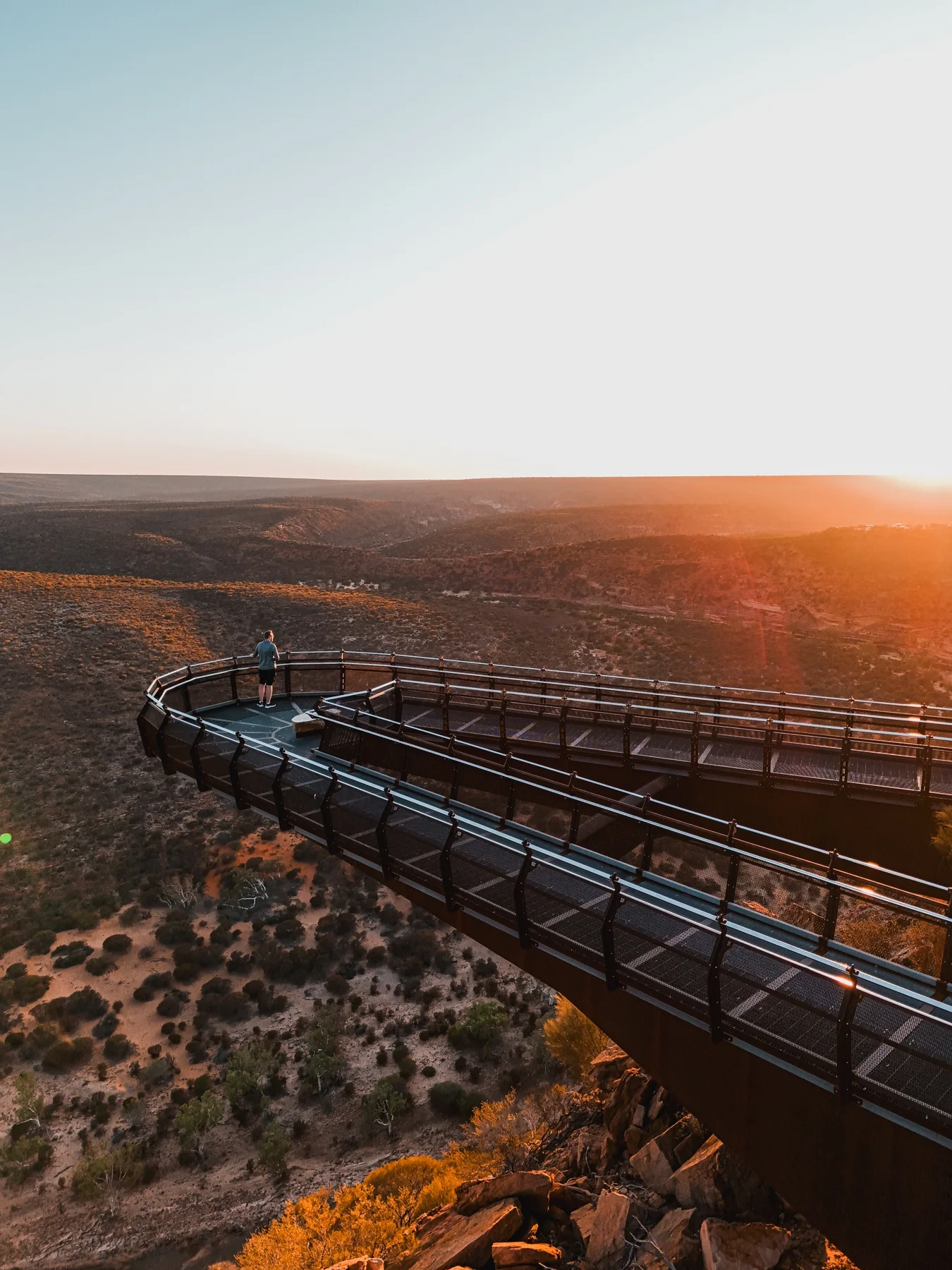
Kalbarri Skywalk sits within one of Western Australia's darkest regions, attracting visitors who book astronomy tours through local operators. This page gathers customer feedback, operator ratings, and firsthand accounts from travellers who joined guided stargazing experiences between early 2025 and mid-2026.
Quick answer
Kalbarri astronomy stargazing tours reviews consistently highlight telescope quality, guide expertise, and the clarity of the Milky Way visible from the Skywalk plateau. Most operators run two-hour sessions departing between 20:00 and 21:00, with equipment provided. Visitors recommend booking at least three days ahead during school holidays, arriving early to secure parking near the trailhead, and bringing warm layers—plateau temperatures can drop 8–12°C after sunset even in summer.
Kalbarri National Park holds a Bortle Class 2 dark-sky rating, meaning the naked eye can resolve the Magellanic Clouds and the zodiacal light on moonless nights. That measurable darkness is what draws astrophotographers and casual stargazers alike to the Skywalk precinct, where the two cantilevered platforms extend over the Murchison River gorge 100 metres below. Tour operators set up Dobsonian and Schmidt-Cassegrain telescopes on the plateau behind the main viewing decks, positioning groups away from the sensor-triggered path lighting that activates near the skywalk edge. Reviews of kalbarri astronomy stargazing tours consistently mention three elements: telescope aperture, guide commentary, and weather contingency. Several operators now use 10-inch or larger reflectors, allowing Saturn's Cassini Division and Jupiter's Great Red Spot to resolve clearly when atmospheric seeing permits. Guides typically walk participants through constellation identification using green laser pointers before moving to deep-sky objects—the Jewel Box Cluster, Omega Centauri, and the Eta Carinae Nebula all sit within comfortable altitude for southern-hemisphere viewing. Most sessions include astrophotography support, with guides assisting visitors to align smartphone cameras through eyepiece adapters for lunar and planetary captures. Weather cancellations surface frequently in kalbarri stargazing tour feedback. The Mid West coast experiences cloud cover on roughly 40 per cent of nights between May and August, and operators typically notify participants by 16:00 on the tour date if conditions are unsuitable. Refund and rescheduling policies vary by provider, so confirming those terms at booking is standard advice. The park entry fee of 17 AUD per standard vehicle covers day access but remains valid until midnight, meaning a single pass works for both daytime gorge exploration and evening astronomy sessions. The Skywalk access road is sealed and suitable for two-wheel-drive vehicles, though roadside kangaroo activity increases sharply after dusk—most operators recommend convoy driving or following guide vehicles when departing after 22:00. Customer feedback also flags practical details: the plateau is fully exposed, and wind speeds above 25 kilometres per hour can destabilise tripod-mounted optics, occasionally forcing operators to relocate to the Z Bend carpark five kilometres south. Toilet facilities close at the visitor centre by 17:00, and no water is available on-site after hours. Mobile reception from Telstra covers the Skywalk area intermittently, but Optus and Vodafone users should expect no signal. Reviews from families note that children under eight often lose interest after the first 30 minutes unless operators incorporate myth storytelling or constellation apps into the session, a feature now offered by two of the three active tour providers in the region.
“The Milky Way's core stretched from horizon to horizon, and through the telescope we could see the dust lanes threading through Sagittarius—detail I'd only ever seen in textbook images.”
Visitor reviews consistently highlight the value of expert guidance and specialized equipment when exploring the night skies near Kalbarri National Park.
Equipment quality expectation
Prepare for local conditions
Verify group size constraints
Plan your own transport
Customer reviews frequently highlight avoidable errors that diminish the stargazing experience. Most complaints trace back to poor preparation around moon phases, clothing, and equipment expectations.
Booking tours during full moon periods
Check the lunar calendar before reserving—new moon phases (0-10% illumination) deliver the darkest skies and clearest Milky Way views. Local operators publish moon-phase calendars on their booking pages.
Arriving in summer clothing for desert night conditions
Desert temperatures drop 15-20°C after sunset year-round. Bring layered fleece or down jackets, long trousers, and closed shoes even in warmer months.
Expecting provided telescopes without confirming tour inclusions
Not all operators supply optical equipment. Read the specific tour description carefully—some focus on naked-eye observation and constellation storytelling, while others include telescope viewing sessions.
Underestimating the drive time from Kalbarri town to dark-sky sites
Tour departure points often lie 20-40 minutes beyond the town center along unsealed roads. Confirm the exact meeting location when booking and allow buffer time for navigation.
Bringing white torches instead of red-light alternatives
Standard torches destroy night vision for 20-30 minutes and disrupt the group. Use red-filtered headlamps or phone apps with night-mode settings to preserve dark adaptation.
Kalbarri National Park is open to visitors daily, providing access for evening and night-time stargazing activities.
Everything you need to know about kalbarri astronomy stargazing tours reviews
Currently, no commercial operators offer exclusive guided stargazing tours directly on the Skywalk structure itself. Many visitors rely on kalbarri astronomy stargazing tours reviews to compare independent photography workshops and small group excursions hosted nearby.
Users often note that while the park offers dark skies, weather conditions significantly impact visibility. Reading recent kalbarri astronomy stargazing tours reviews helps you understand why clear, moonless nights are preferred for viewing the Milky Way.
Most stargazing experiences in the region provide guided telescope access to view constellations and planets. You can find details about equipment quality and guide expertise within various kalbarri astronomy stargazing tours reviews to inform your choice.
Families are welcome to explore the area, provided they remain supervised at all times. Check specific provider terms in their respective kalbarri astronomy stargazing tours reviews to see if they offer youth-oriented content for night sky exploration.
Most guests emphasize the importance of arriving early to scout the area before full darkness. Popular feedback often mentions the need for warm clothing and a red-light torch to navigate the paths safely while preserving night vision.
The entry fee is 17 AUD per standard vehicle, which covers park access during your visit. This fee is a standard day pass requirement for entering the national park where the Skywalk is located.