
English| EUR
Suggested for you
More currencies
Choose a language
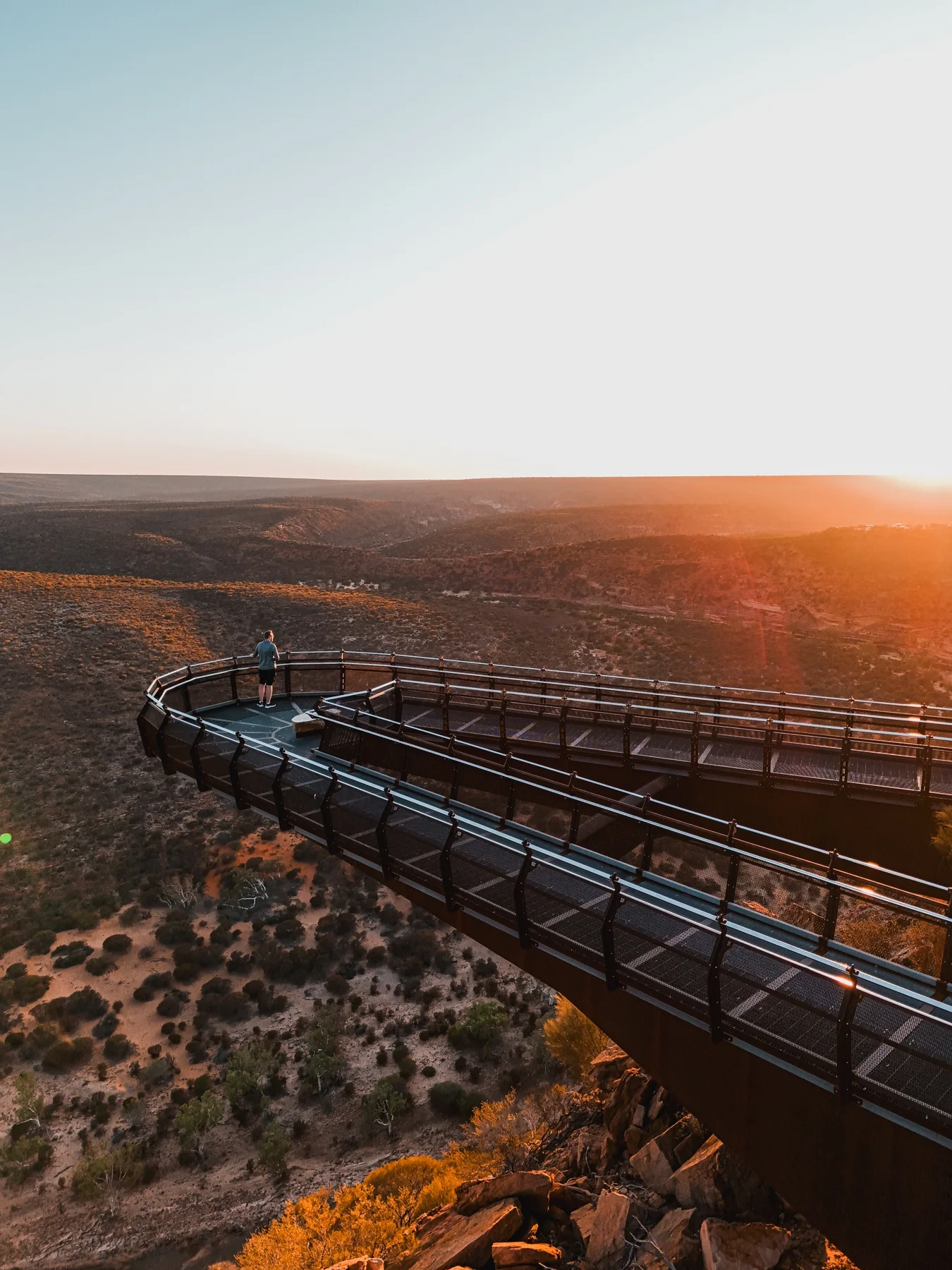
Kalbarri Skywalk sits 580 kilometers north of Perth in one of Western Australia's darkest sky zones. The platform's elevation and distance from major urban centers make it a natural observatory where celestial objects invisible in city environments appear with remarkable clarity.
Quick answer
Kalbarri Skywalk offers exceptional telescope viewing because it sits in a Bortle Class 2 dark sky zone, more than 160 kilometers from the nearest city. Light pollution here measures below 0.05 microcandelas per square meter, allowing visibility of the Milky Way core, nebulae, and deep-sky objects that remain hidden in urban environments where sky glow and artificial lighting wash out faint celestial details.
Kalbarri National Park records a night sky brightness reading that places it among the darkest accessible locations in Western Australia's mid-west. The Skywalk platform, cantilevered 100 meters above the Murchison River gorge, provides an unobstructed 270-degree view with no terrestrial light sources within the immediate sightline. This combination of elevation, geographic isolation, and minimal atmospheric interference creates conditions that urban and suburban observers rarely experience. Light pollution degrades telescope performance by scattering artificial light through the atmosphere, reducing contrast between celestial objects and the background sky. In metropolitan areas, this sky glow typically limits naked-eye visibility to 50-200 stars. At Kalbarri, observers routinely count 2,000-3,000 stars without optical aid. A telescope amplifies this advantage: faint galaxies, planetary nebulae, and star clusters that require large apertures and dark adaptation in cities become accessible with modest equipment here. The Southern Hemisphere perspective adds objects never visible from northern latitudes, including the Magellanic Clouds, the Carina Nebula, and the galactic center during winter months. Timing shapes the experience. The platform remains open 24 hours, but astronomical twilight—the point when the sun drops 18 degrees below the horizon—occurs approximately 90 minutes after sunset. Moon phase matters more than weather in this arid climate: a full moon raises sky brightness by two Bortle classes, rendering faint deep-sky targets invisible. New moon periods between March and October align with stable atmospheric conditions and comfortable overnight temperatures. Wind on the gorge rim can destabilize tripod-mounted equipment; mornings between 06:00 and 10:00 typically offer calmer air, though stargazing during these hours is limited to pre-dawn in winter. The absence of light pollution also means no ambient illumination for setup or navigation. Red-filtered headlamps preserve night vision while allowing hands-free telescope operation. The platform surface is steel grating; secure footing and weighted tripod legs prevent accidental movement. Standard park entry applies year-round at 17 AUD per vehicle, with no separate fee for after-hours access.
“At Kalbarri, observers routinely count 2,000-3,000 stars without optical aid, a visibility threshold unreachable in urban environments.”
Urban light pollution often obscures celestial objects, whereas Kalbarri Skywalk offers minimal light interference for clear telescope viewing. Understanding these conditions helps observers distinguish between light-polluted city skies and dark sky locations.
Light dome interference in cities
Atmospheric scattering and city glow
Visible stars in metropolitan areas
Contrast and deep-sky objects
Shielding requirements for urban stargazing
Urban light pollution necessitates specific technical adjustments to maintain contrast and clarity when observing celestial bodies.
Equip your telescope with a broad-band or narrow-band light pollution filter to block wavelengths emitted by streetlights. These filters enhance the contrast of nebulae and galaxies against the sky background.
Focus your efforts on planets like Jupiter or Saturn and the Moon, as their high surface brightness allows them to remain visible despite ambient light. Avoid faint deep-sky objects that require pristine dark skies for detection.
Construct a shroud around your telescope aperture to prevent stray light from local sources from entering the eyepiece. This physical barrier ensures your eyes remain adapted to the dark environment.
When viewing from bright areas, use higher magnification eyepieces to darken the background sky by narrowing the exit pupil. A darker background effectively increases the visibility of high-contrast targets.
Stay in the darkest available corner of your observing site for at least thirty minutes before looking through the telescope. Even minimal exposure to phone screens or security lights resets your night vision and reduces your ability to perceive faint details.
The Kalbarri Skywalk is open to the public daily throughout the week.
The optimal window for stargazing at Kalbarri Skywalk occurs during the new moon phase in the shoulder seasons, specifically April to May or September to October. These months offer clear skies and moderate temperatures, facilitating better visibility when combined with the recommended arrival window of 06:00–10:00 for daytime planning.
Dry and stable; 15°C–25°C
Dark sky conditions minimize light pollution, allowing for deeper telescope observations. Lunar cycles dictate the darkness levels available throughout the month.
Mild temperatures; 18°C–28°C
These periods avoid the intense summer heat and provide high clarity for celestial viewing. Atmospheric stability is generally higher during these transitions.
—
Arriving during the 06:00–10:00 window helps avoid peak heat and large crowds while enjoying the morning light for site orientation.
Verdict: The best time to visit is during a new moon in April, May, September, or October, utilizing the 06:00–10:00 arrival window for daytime logistics before evening stargazing.
Everything you need to know about can you see stars with a telescope in the city
It is difficult to conduct effective astronomy in urban areas because artificial light scatters in the atmosphere, washing out faint celestial objects. While you can see stars with a telescope in the city, the level of detail is significantly reduced compared to dark-sky locations.
Light pollution acts as a veil that hides the Milky Way and deep-sky objects from view. In densely populated areas, skyglow from streetlights and buildings obscures the contrast required for meaningful observation.
The Kalbarri Skywalk offers a remote vantage point with minimal light interference, making it an excellent location for viewing the cosmos. Because it sits within a national park, the absence of urban glare allows visitors to see stars with a telescope in the city in terms of their home-base proximity, but with true dark-sky quality.
Rural sites provide a natural shield against the glow that hinders visibility in towns. When you search for where can you see stars with a telescope in the city, you will often find that professional advice points toward dark-sky reserves where the atmosphere is transparent.
The best time to experience the dark sky at this location is outside of peak daylight hours, though the park is accessible daily. Please refer to our site navigation for recommended arrival windows to avoid peak heat and crowds.
A bright moon, often called light pollution of a natural variety, can wash out dimmer stars and nebulae regardless of your location. Even if you wonder can you see stars with a telescope in the city, the lunar cycle remains the most important factor in determining visibility.
The elevated platform provides an unobstructed horizon, which is ideal for tracking constellations as they rise and set. This physical elevation helps distance the observer from low-level surface reflections that might otherwise interfere with sightlines.
Astronomy in cities is limited primarily to the moon, bright planets, and the most prominent stars. To view galaxies or distant clusters, moving away from the light dome of an urban environment is necessary for a clear experience.